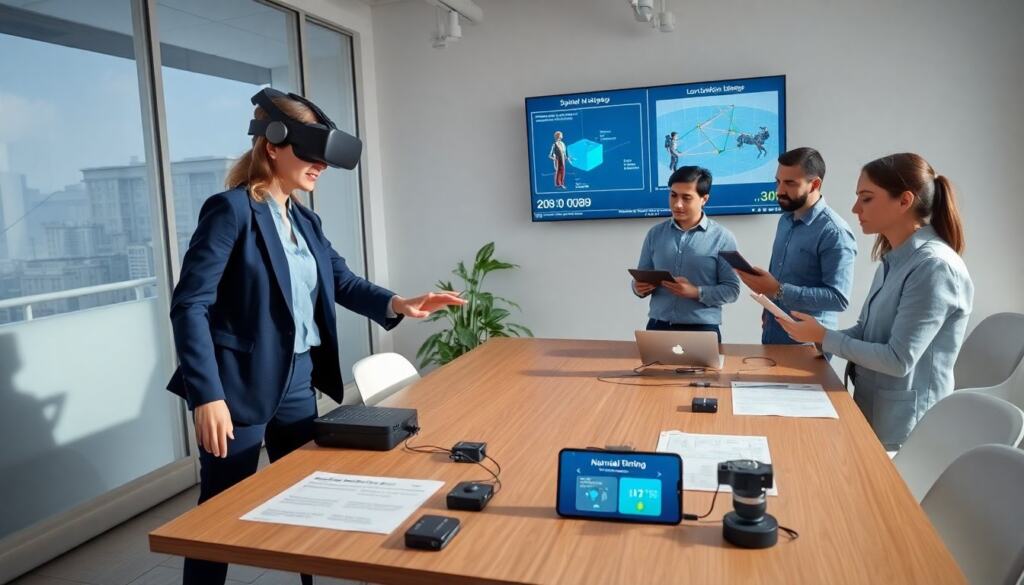
Mixed reality games combine virtual content with real places. They place digital objects in physical space and let players act on both layers. Developers use sensors, cameras, and software to match digital items to room geometry. Players see and touch virtual items while they move in real space. This guide explains how mixed reality games work and what developers should focus on in 2026.
Key Takeaways
- Mixed reality games combine virtual objects with real physical spaces, creating immersive experiences where players interact with both digital and real-world elements.
- Core technologies essential for mixed reality games include spatial mapping, tracking, low-latency rendering, input methods, networking, and AI to ensure natural gameplay and interaction.
- Developers must prioritize player safety by setting clear play boundaries, adapting content to room layout, and ensuring comfort during gameplay.
- Designers should incorporate privacy protections, enable smooth multiplayer synchronization, and offer optional cosmetic monetization while keeping core gameplay accessible.
- Long-term engagement is enhanced through daily tasks, community events, player-generated content, and robust recovery systems for tracking or hardware issues.
- Early prototyping and continuous player feedback help refine interaction timing, object scale, and visual stability to improve the mixed reality gaming experience.
What Mixed Reality Games Are And How They Work
Mixed reality games blend digital elements with a player’s physical world. They show virtual objects that sit in a real room and react to real surfaces. A headset or a mobile camera captures the physical scene. Software then builds a map of that scene and places game objects within it. The system tracks the player’s position and the room layout. The game updates graphics in real time so objects stay fixed to floors, walls, or tables. Players move, grab, or point and the game responds. Developers design rules that keep virtual items consistent with physical laws like gravity and occlusion. These rules make the experience feel real. Mixed reality games often mix single-player puzzles, local multiplayer, and social features. They let players invite friends, share game objects, and leave persistent items in a room.
Under the hood, mixed reality games coordinate multiple subsystems each frame: scene understanding to detect floors, walls, and obstacles; pose estimation to know where the headset and hands are; and collision systems so virtual objects interact believably with the physical world. The virtual content may be anchored to a persistent coordinate system so that the same arrangement returns when a player revisits a space. In practice, developers balance how much of the environment is modeled on-device versus in the cloud, depending on latency, privacy, and bandwidth trade-offs. Mixed reality also spans a spectrum—from subtle AR overlays on phone screens to fully spatialized experiences through headsets—so designers and engineers choose interactions that suit the hardware profile and the expected play area.
Player experience in mixed reality games depends heavily on contextual awareness. Games use environmental cues and adaptive mechanics: spawn points avoid fragile real-world objects, puzzles scale to room size, and audio occlusion reflects walls so sound feels anchored. Onboarding is critical—clear visual guides, short tutorials, and calm calibration steps reduce frustration. Accessibility considerations such as seated modes, adjustable movement speeds, and alternative input mappings ensure more players can enjoy mixed reality titles without unnecessary strain.
Core Technologies Powering Mixed Reality Games
Mixed reality games rely on a few core systems. They need spatial mapping to know the room shape. They need tracking to follow the player and controllers. They need rendering to show visuals with low latency. They need input methods so players can act. They need network code when multiple people share the same scene. They need AI for object behavior and voice handling. These systems work together to make the game feel natural and predictable. Hardware and software choices shape game scope and scale. Many teams target headsets for full immersion or phones for wider reach. Teams balance visual fidelity against frame rate and battery life. They choose middleware for physics, voice, and cloud sync to speed development.
Spatial mapping commonly combines depth sensors, stereo cameras, and SLAM (simultaneous localization and mapping) techniques to build and update a geometry mesh or semantic map of the environment. Robust tracking fuses IMU data, computer vision, and occasionally external beacons to maintain low-latency, high-precision pose estimates. Rendering pipelines emphasize predictability: stable framerates, reprojection strategies, and perceptual foveation reduce motion sickness while maximizing visual detail where the player is looking. For input, mixed reality games integrate hand tracking, controller gestures, gaze, voice, and occasionally physical peripherals; the best experiences provide smooth fallbacks between inputs depending on what the device supports.
Networking for shared mixed reality scenes adds further complexity. Synchronization systems usually send compact authoritative state updates and rely on client-side prediction and interpolation to hide latency. Cloud services can host persistent world state, user-generated content, and cross-device identity, but developers must design to tolerate intermittent connectivity and reconcile divergent local maps when players join from different devices. AI enhances mixed reality games by powering believable NPC behavior, adaptive difficulty, procedural content placed to match room layouts, and natural-language interfaces. Tooling—editors that visualize spatial anchors, simulators that emulate different room sizes, and automated telemetry pipelines—speeds iteration and helps teams identify platform- or device-specific issues early.
Design Principles And Best Practices For Mixed Reality Game Developers
Designers keep player safety and comfort as the top priorities. They set clear play boundaries and add soft stops when players approach hazards. They require explicit consent for room scanning and data collection. Designers adapt game content to room size and layout. They place important objects within the player’s reachable space. They avoid forcing players to make sudden, large movements. They use stable anchors so virtual items do not drift. The team prototypes early with simple tools and plays the game in real rooms. They collect quantitative telemetry and player feedback to find pain points. They iterate on interaction timing, object scale, and visual contrast. Designers handle multiplayer by syncing only essential state and predicting movement to mask latency. They encrypt shared data and allow players to control privacy settings. For monetization, teams offer cosmetic items and optional expansions while keeping core gameplay accessible. For long-term engagement, designers add daily tasks, community events, and creation tools so players add content. They document common failure modes and provide clear recovery flows so players return to play quickly after a tracking drop or hardware hiccup.
Concrete best practices include: building a short, context-aware onboarding flow that calibrates play area and demonstrates core interactions; providing clear visual and haptic feedback for object selection and collisions; and offering multiple locomotion options (teleport, smooth, seated) to accommodate comfort levels and room constraints. Designers should favor affordances that communicate scale and depth reliably—high-contrast edges, consistent shadowing, and small amounts of motion parallax—to keep virtual objects readable in varied lighting. When designing multiplayer, consider social norms and moderation tools because mixed reality often invades personal spaces; enable private rooms, user blocking, and reporting to maintain a healthy community.
Operationally, ship with robust diagnostics and recovery: automatic relocalization prompts, quick recalibration flows, and checkpoints that tolerate a temporary loss of tracking. Instrumentation helps teams measure drift, dropped frames, input latency, and user abandonment points so updates can target real problems. Accessibility, localization, and performance budgeting are not optional—support multiple languages, flexible play modes, and strict CPU/GPU budgets per target device. Finally, iterate with real players in realistic environments rather than relying solely on lab tests: observing how people rearrange furniture, react to occlusion, or prefer to sit versus stand yields design changes that materially improve adoption and retention of mixed reality games.