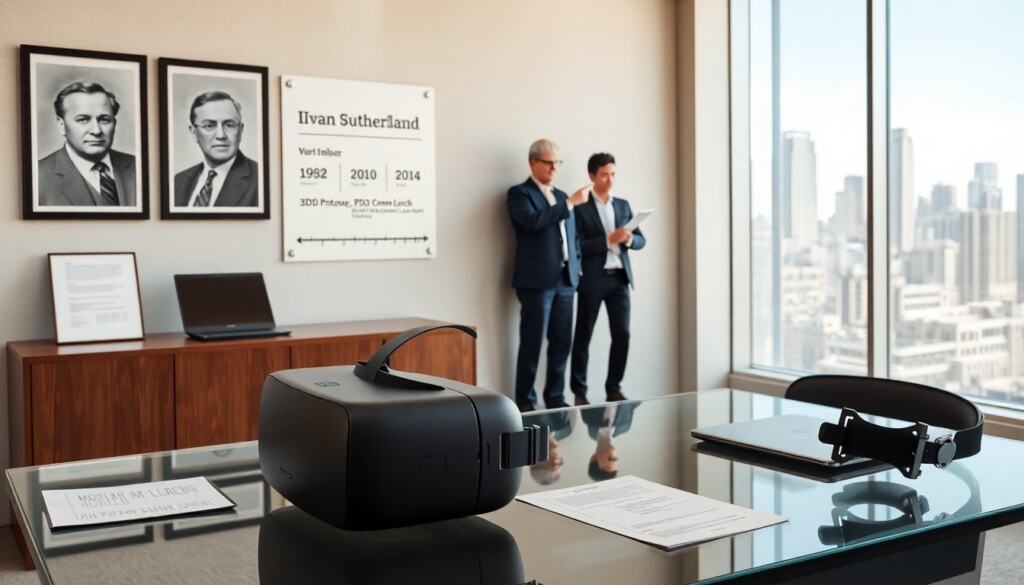
Who invented the VR headset is a common search. The question lacks a single answer. Early devices, academic labs, and companies each added parts. Some built displays, others built tracking or lenses. Many people filed patents and built prototypes. Credit spreads across engineers, designers, and researchers from the 1950s to today.
Key Takeaways
- The VR headset has no single inventor; its development spans contributions from many engineers and researchers since the 1950s.
- Morton Heilig created the immersive Sensorama in 1962, while Ivan Sutherland built the first head-mounted display prototype in 1968.
- Jaron Lanier popularized the term “virtual reality” and helped commercialize VR headsets in the 1980s, advancing public awareness.
- Palmer Luckey’s 2010 affordable headset prototype led to the Oculus Rift, sparking a modern VR market surge.
- Continuous improvements in optics, tracking, displays, and software by multiple companies and labs shaped today’s VR headsets.
- Patents, parallel innovations, and market success complicate attributing the invention to a single person, highlighting collaborative progress.
The Short Answer: No Single Inventor — How Credit Is Shared
Who invented the VR headset does not name one person. The invention grew in stages. Morton Heilig built the Sensorama in 1962. Heilig added audio, scent, and motion to create immersion. He did not build a head-mounted display. Ivan Sutherland built a head-mounted display prototype in 1968. Sutherland used mechanical tracking and simple graphics. His work showed that a person could wear a display and see virtual images. Researchers at universities and companies improved lenses, tracking, and graphics over decades. In the 1980s, Thomas Caudell coined the term “augmented reality,” while Jaron Lanier popularized the phrase “virtual reality” and helped commercialize headsets in the 1980s. Sega, Nintendo, and other firms experimented with consumer headsets in the 1990s. Palmer Luckey later created a modern affordable prototype in 2010. Luckey’s prototype led to the Oculus Rift and a new market. Each step added a needed element: display quality, low-latency tracking, compact optics, and content platforms. Patent filings and commercial products often assigned credit to companies. Academic papers and lab reports credited individual researchers. Historians credit many contributors rather than a single inventor. When people ask who invented the VR headset, the best answer lists key contributors and explains how their work combined into today’s headsets.
Timeline Of Key Milestones And Contributors
Who invented the VR headset becomes clearer when viewed as a timeline. The timeline shows specific inventions and people who contributed parts.
1962, Morton Heilig built the Sensorama. Heilig created a multisensory arcade-style machine. It offered film, stereo sound, scent, and seat motion.
1968, Ivan Sutherland created the first head-mounted display prototype. Sutherland used an optical see-through approach and mechanical tracking. He published technical details and inspired computer graphics research.
1970s, Military and aviation research advanced helmet-mounted displays. Engineers improved gyroscopes, optics, and head tracking for pilots.
1980s, Jaron Lanier founded VPL Research. VPL sold data gloves and headsets to labs and museums. Researchers developed better tracking algorithms and stereoscopic displays.
1990s, Consumer experiments arrived. Sega released a headset prototype concept. Nintendo released the Virtual Boy, which failed commercially but pushed stereoscopic display work.
2000s, Graphics power and sensors improved. Motion sensors from gaming consoles and MEMS gyros became common. Universities and labs published refined tracking and rendering methods.
2010, Palmer Luckey built a low-cost headset prototype. He focused on high field-of-view optics and low-latency rendering. Luckey launched a Kickstarter campaign and founded Oculus VR.
2014, Facebook acquired Oculus. The acquisition spotlighted VR and brought high investment in displays, optics, and content.
2010s–2020s, Companies such as HTC, Sony, Valve, and Meta shipped consumer headsets. They improved resolution, refresh rate, and standalone operation.
2020s, Inside-out tracking, compact passthrough cameras, and lightweight optics became standard. Standalone headsets removed the need for external sensors.
The timeline shows that many people and groups added parts. Each entry solved a technical problem. That pattern explains why no single person holds full credit.
Why Attribution Is Complicated: Patents, Prototypes, And Parallel Development
Who invented the VR headset is hard to pin down because people worked in parallel. Engineers filed patents that covered optics, displays, or tracking. Some patents overlapped. Companies built prototypes that never reached market. Universities published papers that described core ideas but did not commercialize them. Multiple teams solved similar problems at similar times. Legal claims sometimes assign credit to a company rather than a person. Funding and market success also shape who gets public credit. For example, Heilig and Sutherland influenced technical foundations. Lanier, Luckey, and commercial firms drove public awareness and market adoption. Patent law awards rights to specific inventions, not to the entire system of a headset. The headset requires multiple inventions to work well: a display, optics, tracking, software, and content. Because of this, historians and technologists cite many names when they answer who invented the VR headset.