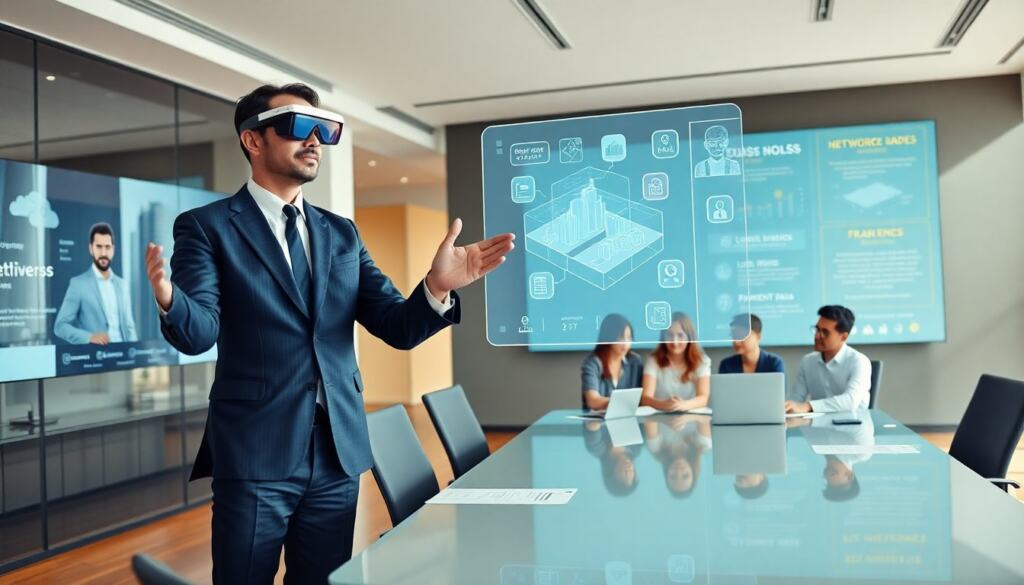
What is a metaverse is a common question in 2026. The term means a shared virtual space that people enter with devices. The metaverse links digital worlds, services, and users. It lets people meet, work, learn, and trade in virtual places. This article explains what is a metaverse, how core tech works, common uses, and how identity and economy function.
Key Takeaways
- A metaverse is a shared virtual space where users interact as avatars across linked digital worlds and services.
- Core technologies powering the metaverse include extended reality devices, real-time 3D engines, spatial computing, and high-performance networks.
- Users engage in the metaverse for socializing, work, education, entertainment, and commerce, benefiting from immersive and persistent experiences.
- Digital identity and ownership in the metaverse rely on wallets, tokens, and interoperable standards to secure assets and enable transactions.
- Interoperability and governance are critical for seamless asset portability and trusted user interactions across multiple metaverse platforms.
- Advancements in hardware and software continue to enhance metaverse access, making experiences more comfortable and widely adopted.
What People Mean By “Metaverse” Today
People use the phrase “what is a metaverse” to ask about persistent online virtual space. They mean an environment where users meet as avatars and interact in real time. Companies build linked virtual worlds, persistent economies, and social tools. Users expect continuity: assets and identities that move across scenes. The phrase covers many models: single-platform virtual worlds, linked platforms that share standards, and enterprise virtual workspaces. Observers watch technical progress, user uptake, and governance rules. They assess value by activity, asset ownership, and real-world ties.
When someone asks what is a metaverse, they are often probing both technical and social aspects. Technically it is a set of interoperable systems that maintain persistent state and render 3D spaces; socially it is a place where norms, roles, and communities form. Expectations vary: some imagine fully immersive VR neighborhoods, others expect lightweight AR overlays on daily life. The term also includes mixed ecosystems where corporate, open-source, and academic projects each contribute parts of the experience.
A practical way to think about the metaverse is as a stack: the device and interface layer, the rendering and physics engines, the identity and economic layer, and the network and governance layer. Different products emphasize different layers, so discussions about the metaverse often focus on how those layers interoperate and who controls them. Concerns about privacy, safety, and inclusion are now central to conversations about what the metaverse should be and how it should evolve.
Core Technologies Powering The Metaverse
Developers combine hardware, software, and networks to deliver metaverse experiences. They optimize rendering engines, cloud servers, identity layers, and payment rails. Companies use standards to enable asset portability and real-time sync. The stack must support low-latency audio and video, synchronized physics, and secure transactions. Engineers scale services with edge compute and content delivery. They design APIs that let creators publish scenes and items. The next two subheadings explain key technology areas.
Beyond the visible elements, middleware and orchestration systems coordinate matchmaking, presence, and persistent storage. Content pipelines transform artist assets into optimized runtime formats, and content moderation systems apply policies across spaces. Telemetry and analytics help teams measure engagement, detect problems, and iterate on experiences. Security controls protect user data and financial transactions while compliance and logging assist organizations in meeting regulatory requirements.
Open standards and composability are important technical goals. When engines, file formats, and identity protocols are interoperable, creators can reuse assets and users can move between platforms with fewer barriers. Many projects focus on common APIs for avatars, animation rigs, and digital object metadata so tools and marketplaces can interoperate without reinventing basic capabilities.
Extended Reality: VR, AR, And Mixed Reality
Extended reality devices let users enter or overlay virtual content. VR headsets block the physical view to create full virtual space. AR glasses overlay digital objects onto the real scene. Mixed reality blends both to let virtual and physical objects interact. Developers design interaction models for controllers, hands, and voice. They optimize comfort, field of view, and battery life. Adoption rises as headsets get lighter and software grows. Users expect metaverse platforms to support both immersive and overlay experiences.
Interaction design in XR includes locomotion, object manipulation, and social presence. Designers must balance immersion with accessibility and motion sickness mitigation. For many users the first contact with the metaverse will be through smartphones and desktop clients that provide some features without requiring headsets; this tiered access model is important for broad adoption. Accessibility features—captioning, alternative input methods, and adjustable comfort settings—are increasingly standard in mature platforms.
Real-Time 3D Engines, Spatial Computing, And Networks
Real-time 3D engines render scenes at interactive frame rates. Spatial computing maps physical spaces and aligns virtual objects to them. High-performance networks deliver synchronized state to many users. Cloud servers stream scene data while edge nodes reduce lag. Developers use compression, level-of-detail, and prediction to save bandwidth. They test for scale with simulated users and region failover. The technical goal is to keep interactions smooth and predictable as user counts grow.
Spatial audio, haptics, and synchronized physics increase the sense of presence and make collaboration more natural. For large shared spaces, hybrid architectures mix authoritative servers for critical state with peer-to-peer or localized replication for transient interactions. Observability—monitoring latency, packet loss, frame drops, and server-side load—is essential to operate services that people depend on for work and commerce.
Common Metaverse Experiences And Practical Use Cases
People enter metaverse spaces for social, work, education, and commerce use. Teams meet in virtual conference rooms with shared whiteboards and 3D models. Schools teach with virtual labs and immersive field trips. Designers prototype products in 3D with live collaborators. Brands host shows and sell digital items that fans buy. Gamers play in persistent worlds that evolve with player actions. Retailers let shoppers try goods on virtual avatars before purchase. Cities test planning scenarios with citizens in shared simulations.
Practical use cases extend to healthcare simulations, remote maintenance with AR-guided instructions, and training environments where mistakes are safe and repeatable. For creators, the metaverse provides new business models: subscription services, one-off sales of digital goods, play-to-earn mechanics, and mixed models that combine virtual and physical delivery. Education and workforce development benefit from scenario-based learning and remote mentorship where spatial context improves comprehension.
Everyday consumer experiences include virtual events, social hangouts, and co-watching media with friends. Enterprises apply metaverse concepts to collaboration, remote onboarding, and interactive product demonstrations. Municipalities and planners use shared 3D models and participatory workshops to gather feedback from residents. As these experiences mature, metrics like session length, retention, conversion, and qualitative user feedback guide product decisions.
How Identity, Economy, And Interoperability Work In The Metaverse
Identity, ownership, and standards shape user trust and choice. Platforms offer accounts tied to wallets, keys, or verified credentials. Economies use tokens, stablecoins, and fiat rails for payments. Ownership records live on ledgers or centralized databases. Interoperability depends on common file formats, authentication methods, and exchange protocols. Developers and standards groups work to let assets move between platforms with rules for rights and fees. Regulators watch money flow and data practices and create rules that affect design and trust.
Key challenges include reconciling privacy with portability, enabling secure cross-platform transactions, and establishing dispute resolution mechanisms when assets move between jurisdictions. Governance models range from corporate policy to community-led standards bodies and decentralized autonomous organizations. Each model has trade-offs in speed of decision-making, accountability, and inclusiveness.
Digital Identity, Ownership, And Wallets
Digital wallets store keys that prove ownership of accounts and items. Users link wallets to profiles to show credentials, badges, and items. Platforms let wallets sign actions and accept payments. Some systems use blockchains to record ownership with public proofs. Other systems use private ledgers that platforms control. Developers add recovery and privacy features to reduce account loss and data leaks. Users prefer clear controls that let them move assets and set visibility for personal data.
Practical identity systems combine multiple signals—claims from trusted issuers, behavioral signals, and self-asserted attributes—to reduce fraud while preserving user choice. Recovery mechanisms, social recovery designs, and custodial options are important for mainstream users who are not comfortable managing private keys. Clear UX around permissions, provenance, and transferability helps people understand what they own and what rights they have when engaging across metaverse spaces.