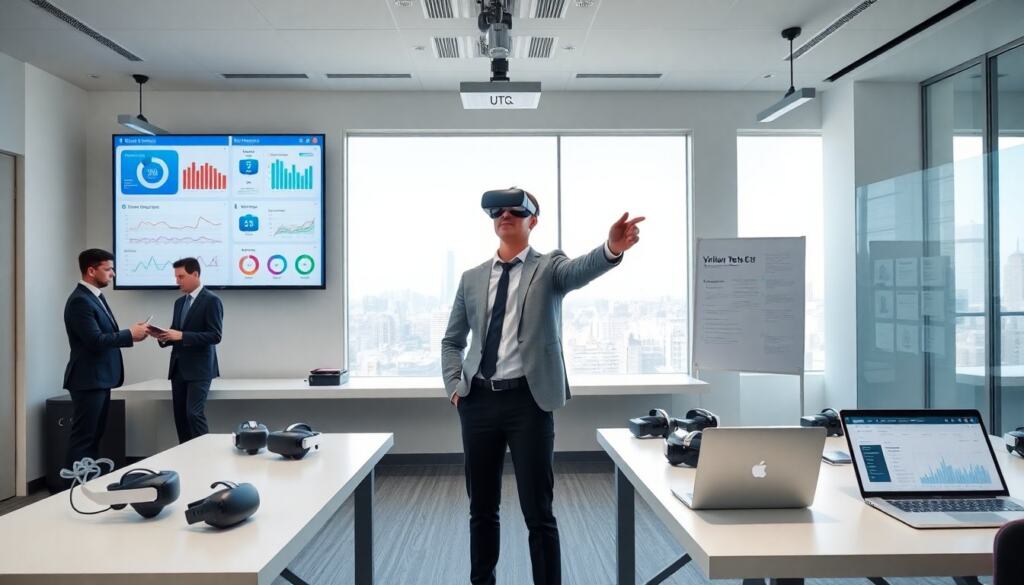
Virtual reality applications show practical value across business and daily life by creating immersive, interactive experiences that go beyond screens and menus. They let users enter simulated spaces for work, learning, therapy, and play, bringing scale, repeatability, and safety to activities that are costly or risky in the real world. The technology combines head-mounted displays, positional and hand tracking, motion controllers, audio spatialization, haptic feedback, and specialized software engines to create consistent, controllable scenes. Organizations test virtual reality applications to reduce cost, speed training, and improve design decisions by validating ideas before committing physical resources. Individuals use virtual reality applications for socializing, fitness, meditation, and entertainment, often blending multiple use cases (for example, a remote collaboration session that also includes a training module). As the ecosystem matures, platform tools, content marketplaces, and device-management services are helping teams move from pilots to scaled deployments while keeping an eye on ergonomics, accessibility, and measurable outcomes.
Key Takeaways
- Virtual reality applications create fully immersive environments using headsets and motion tracking for diverse uses like training, therapy, and entertainment.
- Businesses leverage virtual reality applications to reduce costs, accelerate learning, and improve design by simulating safe, controlled scenarios.
- Healthcare, education, retail, manufacturing, and real estate are leading industries benefiting from virtual reality applications for tasks ranging from surgery rehearsal to virtual tours.
- Successful adoption of virtual reality applications requires addressing technical challenges, user comfort, and clear performance metrics through pilot projects and iterative improvements.
- Future trends in virtual reality applications include enhanced hardware comfort, AI-driven content creation, edge computing for reduced latency, and growing industry-specific ecosystems.
How Virtual Reality Works And Why It’s Different From AR And MR
Virtual reality applications place a user inside a fully simulated environment that can be realistic, abstract, or stylized depending on the use case. A headset displays a stereoscopic view and often provides inside-out or outside-in positional tracking so the system knows where the user is looking and moving. Sensors and controllers track head, hand, and sometimes body position; software updates the rendered scene in real time; and audio and haptic systems reinforce spatial cues so the brain accepts the virtual scene as a plausible space. This combination creates spatial presence and a focused attention state useful for tasks that require immersion, such as complex simulations or exposure therapy.
Augmented reality overlays digital elements on the real world, while mixed reality blends virtual objects that can occlude, collide, or otherwise interact with physical surfaces. Virtual reality differs because it intentionally blocks or replaces the physical scene to provide complete control over stimuli, timing, and environmental variables. That control is why many organizations choose virtual reality applications for training scenarios where repeating identical conditions matters, or for design reviews where the team must evaluate scale and sightlines without building a physical mockup.
Because virtual reality applications fully substitute the user’s environment, they require higher compute power for rendering, more precise motion tracking to avoid perceptual conflicts, and specific ergonomics to maintain comfort during longer sessions. Developers optimize frame rate, latency, field of view, and input fidelity to reduce motion discomfort and simulator sickness. They also factor in onboarding flows, calibration routines, and accessibility options (adjustable locomotion, subtitles, high-contrast modes) so a broader set of users can benefit. Choosing between virtual reality applications, AR, and MR depends on goals: choose VR for immersion and controlled variables, AR/MR when users must stay grounded in the physical world or need hands-free overlays. In practice, many projects use hybrid approaches—VR for initial learning or rehearsal, then AR/MR for in-field support—so teams should design workflows that let users transition between modalities without losing context.
Nine High-Impact VR Applications Across Industries (Healthcare, Education, Retail, Manufacturing, Entertainment, Real Estate, Training, Social, Therapy)
Healthcare uses virtual reality applications for surgical planning, anatomy visualization, and pain management. Surgeons rehearse procedures in patient-specific models to refine approaches and briefing teams; anesthesiologists and nurses train on rare complications in repeatable drills. Patients use VR for exposure therapy, chronic pain relief, and stroke rehabilitation, where graded sensory input and gamified exercises increase engagement and allow clinicians to track progress over time using integrated analytics.
Education benefits from virtual reality applications that simulate labs, historical settings, and field trips that would otherwise be inaccessible or unsafe. Students can practice chemistry techniques in a virtual lab without hazardous materials, or explore remote ecosystems and archaeological sites with guided narratives. Virtual classrooms and collaborative lab environments let instructors observe, pause, and provide targeted feedback while measuring competency through in-experience assessments.
Retail adopts virtual reality applications to create immersive showrooms, try-before-you-buy experiences, and store-layout optimization. Brands use VR to prototype merchandising plans, run customer walkthroughs, and collect behavioral data on product placement and choice architecture, helping reduce returns and accelerate assortment decisions. For high-consideration purchases, virtual try-ons or configured demos shorten the decision cycle by letting customers experience products at scale.
Manufacturing leverages virtual reality applications for digital twins, assembly verification, and operator training. Engineers validate factory layouts and ergonomic factors in VR before committing capital investments; technicians train on equipment maintenance through guided, repeatable scenarios that lower error rates and improve first-time fix rates. VR-driven simulations also support process optimization by running “what if” scenarios without disrupting live production lines.
Entertainment and media continue to drive creative VR applications, with immersive games, narrative experiences, and live virtual events that place audiences inside stories or performances. Content creators are experimenting with presence-oriented design—spatial audio, dynamic lighting, and interactive storytelling—to increase emotional engagement. As tools for multiuser sessions improve, creators can combine synchronous and asynchronous elements for evolving experiences.
Real estate uses virtual reality applications for virtual tours, staged walkthroughs, and remodeling previews. Buyers and tenants can inspect properties remotely, explore alternate finishes, and evaluate sightlines and scale. Developers use VR to demonstrate unbuilt space during sales and leasing cycles, reducing time to decision and broadening the buyer pool beyond local markets.
Training across sectors—from emergency response to customer service—uses virtual reality applications to deliver high-fidelity scenarios that emphasize decision-making under pressure. Trainees repeat scenarios with immediate feedback, engage with simulated stakeholders, and accumulate performance metrics that inform personalized coaching. VR training often reduces training time while increasing retention and transfer of skills to the workplace.
Social platforms and collaboration tools built with virtual reality applications enable remote teams and communities to meet in shared 3D spaces, brainstorm with 3D models, or host social gatherings with more expressive presence than video calls. Persistent virtual venues support ongoing projects and informal interactions that help maintain culture in distributed organizations.
Therapy applications use virtual reality applications for phobia treatment, PTSD interventions, and motor rehabilitation. Therapists control exposure levels, track physiological or behavioral responses, and adapt scenarios in real time to maintain a therapeutic window. Because sessions are repeatable and data-rich, clinicians can demonstrate progress with objective metrics and tailor care plans more efficiently.
Across all these cases, organizations often start with focused pilots that target a single, measurable KPI—time to proficiency, error reduction, reduced travel, or patient-reported outcomes—then expand into broader rollouts once the business case is validated. Vendors support these projects with content libraries, analytics dashboards, device-management tools, and integrations with existing learning-management or clinical-record systems to enable operational tracking and compliance.
Adoption Challenges, Implementation Best Practices, And Future Trends For Organizations
Organizations face a mix of technical, operational, cultural, and cost challenges when adopting virtual reality applications. Technical teams must manage device fleets, ensure consistent tracking performance, and provision network capacity to handle high bandwidth and low-latency requirements. User experience teams must address onboarding, motion-sickness mitigation, and accessibility. Business leaders must justify budgets with clear KPIs and procurement must assess total cost of ownership including training, cleaning and hygiene, insurance, and replacement cycles. Security and data privacy are also critical, particularly in regulated industries that handle health, financial, or personally identifiable information.
Implementation best practices begin with aligning pilot objectives to measurable outcomes and limiting scope so learning is rapid and inexpensive. Steps that help adoption include: defining one target KPI per pilot; selecting appropriate hardware for the user population and use case; creating short, clear onboarding flows; instrumenting experiences to capture usage and performance data; training frontline staff on device care and troubleshooting; and establishing governance for content updates and user permissions. Facilities planning—allocating safe play areas, signage, and cleaning protocols—is often overlooked but essential for reliable operation. Procurement teams should evaluate platforms for ecosystem strength (content libraries, developer support), device-management features, and vendor SLAs for updates and support.
For scaling virtual reality applications, organizations build content pipelines, governance, and centralized support structures. They standardize file formats, accessibility checks, and update cadences so applications remain secure and compatible across devices. Cross-functional committees—bringing together IT, operations, legal, learning and development, and business owners—help balance competing priorities and accelerate adoption. Measuring value requires a combination of quantitative metrics (completion time, error rates, throughput) and qualitative feedback (confidence, comfort, perceived usefulness).
Looking ahead, several trends are likely to shape how organizations use virtual reality applications. Hardware improvements will focus on lighter headsets, longer battery life, and better thermal management to support longer sessions. Edge computing and local rendering strategies will reduce latency for complex, cloud-assisted scenes, enabling richer multiuser experiences. AI-driven content creation and procedural generation will lower production costs and allow faster iteration of training scenarios or product configurators. Industry-specific ecosystems—medical imaging toolchains, industrial simulation libraries, and education curricula—will expand, improving interoperability and reducing the time from concept to deployment. Standards and common APIs are emerging that aim to simplify content sharing across platforms and vendors.
Organizations that plan measurable pilots, invest in people and support processes, and build a roadmap for content, devices, and governance will extract the most value from virtual reality applications as the market matures. By combining technical readiness with clear business cases and user-centric design, teams can move beyond novelty to durable improvements in training, operations, customer engagement, and care delivery.