Immersive experience meaning appears in many tech and design conversations. The term describes when a person feels present inside media, space, or software. It covers sight, sound, touch, and interaction. It also covers attention, belief, and emotional response. This article defines the idea, explains how teams build it, and shows how to test whether an immersive experience succeeds.
Key Takeaways
- An immersive experience means the user feels fully present within media, space, or software by engaging multiple senses and interaction.
- Core traits of an immersive experience include sensory coherence, quick interaction response, clear narrative, and meaningful user choices to enhance presence.
- Designers create immersion by aligning sensory input to expectations, providing feedback, and focusing user attention through constraints.
- Technologies like VR headsets, spatial audio, haptic feedback, and eye tracking enable immersive experiences by supporting sensory alignment and responsiveness.
- Testing immersion involves measuring user engagement, error rates, presence surveys, and technical performance metrics to ensure users feel truly present.
- Immersive experiences enhance training, entertainment, retail, and therapy by increasing emotional response, safety, and user control, demonstrating the practical importance of the immersive experience meaning.
Defining An Immersive Experience — Core Traits And How It Feels
An immersive experience meaning focuses on the user’s sense of presence. Presence means the user feels located inside the content or place. Designers create presence by matching sensory input to expectations. The key traits include sensory coherence, interaction immediacy, narrative clarity, and user agency.
Sensory coherence means sight, sound, and motion work together. Sound aligns with visuals and motion cues. Touch or haptic feedback matches the visual action when available. Interaction immediacy means the system responds quickly. When the system delays, the user notices and the sense of presence drops.
Narrative clarity gives the user a clear reason to stay engaged. A short, focused narrative helps attention. The narrative can be literal story, task structure, or clear environmental goals. User agency means the person can make meaningful choices. Choices make the person feel responsible for outcomes. This sense of control increases immersion.
How an immersive experience feels varies by person. Some users describe it as forgetting the real room. Others say it feels like a strong emotional reaction. In all cases, the experience shifts attention away from the environment and toward the content. That shift marks the practical meaning of immersive experience.
How Immersive Experiences Are Built — Design Principles And Technologies
Teams build immersive experience meaning by combining design rules with technology. The design rules center on alignment, feedback, and constraints. Alignment means aligning inputs to expectations. Designers ensure visual scale matches physical scale. They match audio direction to visual sources. Feedback means the system confirms actions. The system uses visual cues, sounds, or haptics to confirm user choices. Constraints guide attention. Designers remove distracting options and focus the user on key elements.
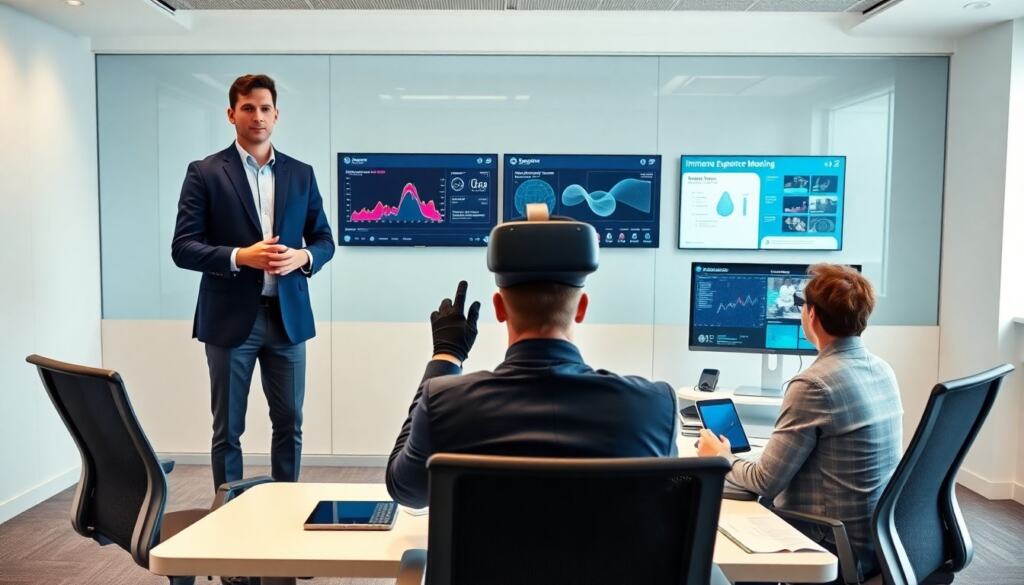
Technology provides the tools that enable those rules. Virtual reality headsets supply head-tracked visuals and spatial audio. Augmented reality overlays digital objects onto the real world. High-refresh displays and low-latency networks reduce lag. Haptic devices provide touch cues. Eye tracking helps adjust focus and resolution where the user looks. Spatial audio engines place sound in three dimensions.
The team mixes hardware and software to reach the target quality. They tune frame rates, lower latency, and test audio placement. They simplify controls so the user can act without thinking about the interface. They use lightweight physics and steady animation to avoid motion conflicts. They also use processes. Iterative testing with real users reveals where presence breaks. Developers fix the break points and re-test.
The combination of design and tech defines the deliverable. When both align, the user feels present. That outcome captures immersive experience meaning in practice.
When An Experience Is Truly Immersive — Practical Tests, Metrics, And Use Cases
A team can test whether immersive experience meaning holds by using practical checks. The first check asks whether the user loses track of time. Time loss often indicates deep engagement. The second check measures error rates on tasks that require attention. Low error rates suggest attention focus. The third check captures self-reported presence through short surveys. Questions ask whether the user felt inside the scene and whether they reacted as if the scenario were real.
Quantitative metrics help too. Teams measure frame rate, input latency, and tracking accuracy. They log motion-to-photon latency and audio sync. They record how long users remain active and how often they return. They use heat maps and gaze paths to confirm where users look. They track decision points to see if users act with confidence.
Use cases show how immersive experience meaning matters. In training, immersive systems let learners practice risky tasks without danger. Pilots can rehearse emergency procedures. Surgeons can rehearse complex operations. In entertainment, immersive media produces stronger emotional response and memory. In retail, virtual showrooms let shoppers inspect products at scale. In therapy, controlled exposure helps treat phobias and stress.
Teams choose tests and metrics based on goals. For attention goals, they measure time and gaze. For performance goals, they measure errors and task completion time. For emotional goals, they measure self-reported presence and physiological signals such as heart rate. These measures make the term immersive experience meaning operational and measurable. They let teams improve design with clear, testable targets.