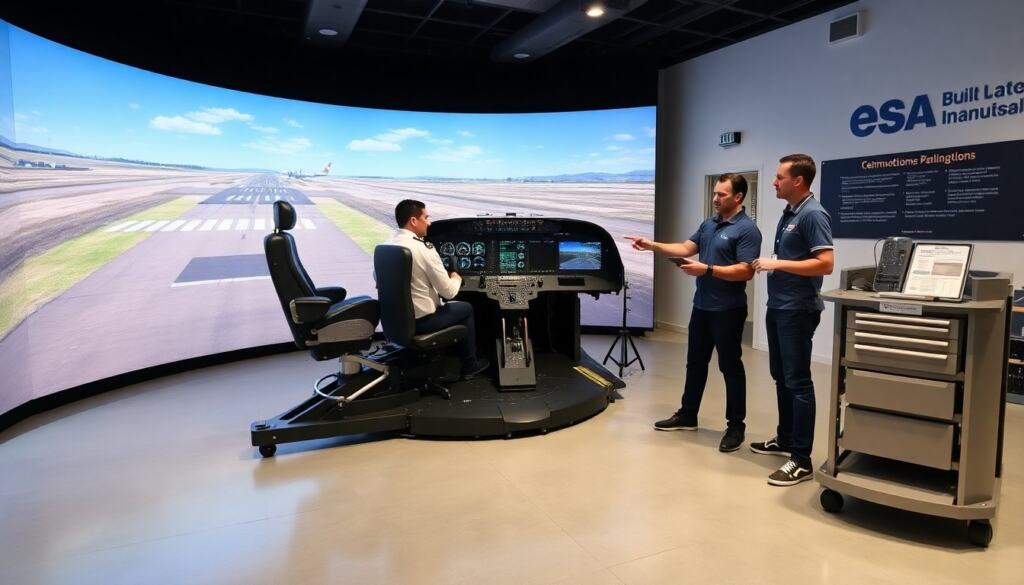
A full motion flight simulator lets trainees practice real flight tasks without leaving the ground. This full motion flight simulator reproduces aircraft motion, visuals, sounds, and control forces to create an immersive training environment. By simulating maneuvers, emergencies, and procedural flows, it helps pilots build skill, reduce operational risk, and lower overall training cost compared with repeated live flying. This guide explains how a full motion flight simulator works, who uses it, and what to check before buying. Readers will learn the core parts, motion methods and cueing, common operational uses, the advantages and trade-offs versus fixed-base units, and practical selection and installation steps so they can evaluate systems against their training objectives and budgets.
Key Takeaways
- A full motion flight simulator replicates aircraft motion, controls, and visual/audio cues to deliver realistic pilot training without actual flight.
- Flight schools, airlines, military units, general aviation owners, researchers, repair shops, and entertainment operators all use full motion flight simulators for type conversions, recurrent checks, development, and outreach.
- Core components include a certified cockpit or replica, a motion platform (commonly hexapod/Stewart-style or a larger 6-DOF system), wide-field visual displays, flight and aerodynamic models, instructor/operator stations, and a data capture/analysis suite.
- Motion cueing algorithms are essential: they translate aircraft accelerations into platform motions within mechanical limits, preserving cues that matter for control and orientation while limiting false sensations and simulator sickness.
- Full motion simulators offer vestibular and kinesthetic fidelity that fixed-base simulators cannot, improving training for manual handling, upset recovery, and spatial orientation — but they come with higher initial cost, facility demands, and maintenance.
- Choosing the right full motion flight simulator requires matching degrees of freedom and motion range, visual fidelity and latency, software model accuracy, certification needs, lifecycle costs, and installation constraints to the specific training syllabus.
What Is A Full-Motion Flight Simulator And Who Uses It?
A full motion flight simulator recreates aircraft movement, control feedback, and environmental cues so pilots can practice tasks that would otherwise require live flight. It typically combines a cockpit shell or certified replica, force‑feedback controls, immersive visuals and audio, and a motion base that imparts pitch, roll, yaw and linear accelerations. Users range from large airline training centers and military units to smaller flight schools and corporate/operators. Airlines and type-rating centers use full motion flight simulators for initial type conversions, line‑training, and recurrent checks where regulatory credit is required. Military organizations employ them for tactics, weapons systems training, and mission rehearsal. Universities and human-factors labs use full motion setups for research on workload, automation interaction, and pilot physiology. General aviation owners and maintenance organizations may use smaller, lower-cost full motion rigs to practice emergency procedures or to reproduce faults for troubleshooting. Finally, entertainment venues and museums often adopt simplified motion rigs to demonstrate flight sensations and attract visitors while educating the public.
Key Components Of A Full-Motion Simulator And How Motion Systems Work
A full motion flight simulator integrates several subsystems. The cockpit or fuselage replica provides ergonomically placed controls, displays, and avionics that match the target aircraft; in higher‑fidelity trainers this cockpit may be certified to meet regulatory standards. The motion platform is typically a 6‑degree‑of‑freedom mechanism (often a Stewart or hexapod design) that can translate and rotate the cockpit to simulate accelerations and attitudes. Larger simulators may use extended-range platforms or motion systems with physical translation rigs for enhanced cues. Visual systems range from single- or multi-projector domes to LED or collimated displays; important specs include field of view, resolution, frame rate, and latency. Computing systems run the aerodynamic and engine models, render visuals, manage avionics emulation, and record data; these often include redundant or real-time operating environments for safety and reliability. Sensors and feedback loops—encoders on controls, inertial measurement units on the platform, and environmental sensors—keep the simulation synchronized and feed data to the instructor/operator station where scenarios, failures, and assessments are controlled. Together these elements produce synchronized visual, vestibular, auditory, and tactile cues critical to training motor skills, decision making, and systems management.
Motion Cueing Algorithms: Making Motion Feel Real
Motion cueing algorithms are the mathematical core that turn aircraft accelerations and angular rates into safe, believable commands for a limited-range motion platform. Because platforms cannot exactly reproduce sustained accelerations or extreme maneuvers, algorithms split the input into components: short, high-frequency cues are reproduced as direct platform motions while long, low-frequency accelerations are represented by sustained platform tilt and visual/vestibular interplay. Cueing filters and washout functions remove slow drift that would push the platform to its limits and apply coordinated washout maneuvers to return the system to neutral without the pilot noticing. Developers tune gain, bandwidth, and blending parameters for the target aircraft and training tasks; for example, upset-recovery training demands different cueing priorities than instrument-procedure practice. Proper tuning preserves the cues most relevant to pilot control inputs, minimizes false cues that cause disorientation, and reduces simulator sickness. Motion system designers also consider latency, platform agility, and mechanical bandwidth because even small delays or limited angular rates can change pilot behavior and training outcomes.
Real-World Uses: Flight Training, Research, And Entertainment
In operational flight training, a full motion flight simulator is used for type conversions, initial and recurrent training, emergency and abnormal procedures, and upset recovery—all areas where vestibular cues or dynamic motion improve learning transfer. Airlines rely on these simulators to conduct crew pair training, multi‑crew coordination, and abnormal checks under controlled, repeatable conditions. Research organizations and universities employ full motion rigs to study human factors such as workload, attention, and the interaction between automation and manual flying. Aerospace manufacturers and avionics suppliers use simulators to prototype cockpit layouts, test new control laws, and validate autopilots before flight-testing. Maintenance, repair, and overhaul (MRO) providers use simulators to reproduce faults for diagnosis and certifying repair procedures. For public outreach, scaled or simplified full motion simulator attractions at airshows, museums, and VR arcades provide safe, engaging demonstrations of flight dynamics—often using modified cueing to prioritize comfort over perfect fidelity. Across these uses, the repeatability, data capture, and controllable failure injection offered by simulators are major advantages over live flight for both safety and cost-effectiveness.
Benefits And Limitations Compared With Fixed-Base Simulators
A full motion flight simulator provides vestibular and kinesthetic cues that a fixed‑base simulator cannot, improving fidelity for manual handling, turbulence, spatial orientation, and upset recovery. These cues can enhance pilot performance in tasks where motion perception influences control inputs and decision-making. Motion systems also improve realism during approaches, crosswind corrections, and visual/vestibular interactions. However, motion platforms increase acquisition and lifecycle costs, require dedicated floor space and structural support (floor reinforcement and rig anchoring may be needed), and introduce additional maintenance and calibration workload. They may also add failure modes and require trained technicians for repairs. Fixed‑base simulators, by contrast, offer lower cost, simpler installation, and high availability for procedural, avionics, and systems training where vestibular cues are less critical. Training programs must therefore balance fidelity needs, regulatory credit requirements, throughput, and budget: if the syllabus emphasizes manual handling, upset recovery, or motion-dependent cues, a full motion flight simulator can be justified; if the focus is procedure repetition, systems training, or instrument procedures, fixed-base trainers may offer better cost-effectiveness.
How To Choose The Right Full-Motion Simulator: Specs, Certification, Cost, And Installation
Selecting a full motion flight simulator starts with a clear statement of training objectives and performance requirements. Specify degrees of freedom (commonly 6-DOF), motion range and peak angular/linear rates, platform bandwidth, and acceptable latency. For visuals, define required field of view, resolution, contrast, and frame rate; consider collimated or out-the-window display options for approach training. Verify the fidelity of flight and engine models, avionics replication, and data recording for debrief. Confirm the certification level you need—whether for regulatory credit, company SOPs, or internal proficiency—and ensure the vendor can support the certification process with documentation and qualification testing. Prepare a realistic budget that includes purchase price, shipping, site preparation (floor reinforcement, ceiling clearance, and power), installation, spare parts, annual maintenance, and technician training. Ask vendors for on‑site demonstrations, customer references, and a clear warranty and service roadmap. During procurement compare total lifecycle cost and expected training outcomes rather than just upfront price: a higher-fidelity full motion flight simulator can reduce aircraft hours and improve training effectiveness, but only if its capabilities align with the syllabus. Finally, plan the installation timeline, contractor interfaces, and an initial validation phase where scenarios and cueing are tuned to your fleet and instructors before full operational use.