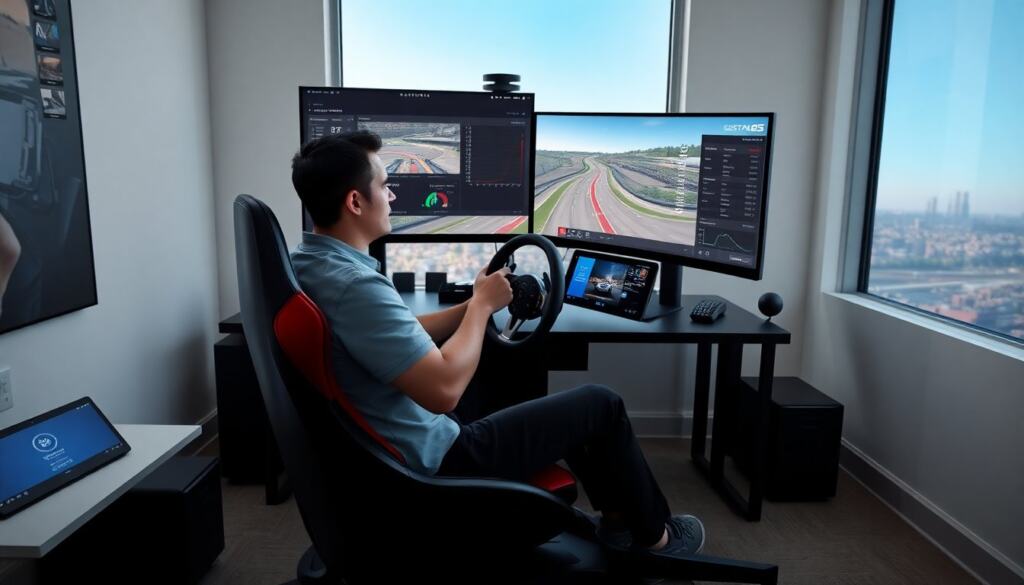
The best sim racing games help players learn car control and race with precision. This guide lists the best sim racing games for realism, online competition, mod support, and beginner access. It will help readers pick a game that fits their goals and hardware. The evaluation uses clear criteria and concise comparisons, and includes practical advice on setups, learning progression, and how to get the most from each category of title.
Key Takeaways
- The best sim racing games combine realistic physics, diverse car classes, and active community support to enhance driving skills and competition.
- Top choices like iRacing excel in competitive online racing with structured series, race control, and ranked ladders for serious drivers.
- For realism and advanced physics, rFactor 2 and Assetto Corsa 2 offer dynamic tire models and precise telemetry favored by experienced sim racers.
- Beginner-friendly sim racing games provide assist options, tutorials, and controller-friendly setups, easing newcomers into the sport.
- A recommended starter setup includes a mid-range force-feedback wheel, pedals with load cell brakes, and stability assists to maximize learning and enjoyment.
- The leading best sim racing games maintain longevity through regular updates, mod support, and compatibility with various hardware including VR and direct-drive rigs.
How We Evaluate Sim Racing Games (Physics, Tracks, Community, And Hardware Support)
We evaluate the best sim racing games across multiple, practical dimensions to give readers a clear view of where each title excels or compromises. Physics testing includes extended seat time in multiple car classes, telemetry analysis where available, and subjective evaluation of force-feedback nuance. Track fidelity is checked by comparing in-game reference points and corner profiles against publicly available track maps and onboard footage. Content depth looks at car variety, official track licenses, event types, and how much playtime the base game delivers before additional purchases are required.
Online systems are judged on matchmaking quality, server stability, ranking mechanics, and how the developer handles griefing and rules enforcement. We assess community and mod support by looking at how easy it is to install mods, the availability of high-quality community content, and whether the developer embraces or restricts user-created material. Hardware support measures compatibility with a spectrum of wheels (USB to direct drive), pedals, shifters, button boxes, VR headsets, and motion rigs, plus how well the game exposes settings for tuning force feedback and input curves.
Finally, we score accessibility and learning tools: tutorial modes, driving schools, assist granularity, telemetry exports, and coaching resources. Value assessment considers initial price, DLC model, frequency of updates, and how long a title will remain relevant for drivers as they improve. The goal is to surface the best sim racing games for different kinds of players—from weekend hobbyists to aspiring e-sports racers—so readers can match games to goals and hardware without guessing.
Best Overall Sim Racing Game In 2026
The best overall sim racing game balances fidelity, content, accessibility, and community health. In 2026, this title distinguishes itself by offering a wide roster of licensed cars and tracks, consistent developer support, and a multiplayer ecosystem that serves casual and competitive players. It provides strong physics that are believable without being punishing to newcomers, and exposes advanced setup options for players who want to dig into suspension, aero, and tire behavior. Importantly, it supports a broad range of hardware, from entry-level wheels to high-end direct-drive rigs and VR.
What makes it a strong overall pick is the way it caters to different goals. Casual players get assist options, quick play modes, and approachable handling. Club and aspiring pro drivers find ranked events, telemetry exports, and detailed setup screens for fine-tuning. The game’s modding scene and official DLC provide long-term variety, while regular patches address bugs and adjust balance. If you’re choosing one of the best sim racing games to cover most bases—learning, practicing, streaming, and competing—this title offers the best single-package experience in 2026.
What Makes The Best Overall Pick Stand Out (Graphics, Modability, And Longevity)
Graphics and presentation matter less for lap time but more for immersion and clarity. The best overall sim racing game uses lighting and track detail to communicate braking points and grip changes without distracting the driver. Modability is another major factor: a healthy workshop extends the game with community cars, tracks, and HUDs that cater to specific series or vintage racing. A developer that supports modders—and maintains compatibility through updates—adds years of value to the base title.
Longevity also depends on a transparent update cadence, clear roadmap, and active engagement with community feedback. Titles that offer robust telemetry output and replay tools make it easier for drivers to analyze laps and share setups, which fosters improvement and community content. For players investing in hardware and time, those combined elements—visual clarity, extensibility through mods, and a stable development path—help a game remain among the best sim racing games for multiple seasons.
Best For Competitive Online Racing: iRacing And Similar Ladders
iRacing is widely regarded as the benchmark for competitive online racing among the best sim racing games thanks to its rule-enforced environment, safety ratings, and officially sanctioned series. Its strengths include race control systems, stewarding processes, and a ladder structure that rewards clean, consistent driving. Laser-scanned tracks and licensed cars help ensure parity and predictable behavior across competitors, which is crucial when races are decided by tenths or hundredths of a second.
For drivers focused on competition, the platform’s event scheduling, practice/qualify/race workflows, and clear license progression create a professional-like ecosystem. Alternatives that adopt ladder formats often trade off some of iRacing’s strict officiating for more open modding and lower barriers to entry but may lack the same level of matchmaking integrity. When selecting one of the best sim racing games for competitive play, consider the balance between strict officiating and community-driven formats, and choose a platform that fits whether you want formal rankings or a more social competition scene.
Best For Realism And Advanced Physics: rFactor 2 And Assetto Corsa 2
rFactor 2 and Assetto Corsa 2 stand out among the best sim racing games for players who prioritize detailed physics and fine-grained setup work. rFactor 2 is known for dynamic track conditions and sophisticated tire models that simulate thermal and wear effects over a stint, which influence strategy and setup choices. Assetto Corsa 2 emphasizes updated aerodynamics and tire behavior along with modern rendering, making it appealing to drivers who want a realistic feel paired with contemporary visuals.
Both titles reward patience: understanding their deeper systems—such as tire temperature management, aero balance shifts, and suspension tuning—leads to measurable gains in lap time and consistency. These games are often the go-to for drivers using motion rigs, direct-drive wheels, and advanced telemetry tools because the feedback they provide is detailed enough to inform engineering-style setup changes. If your priority among the best sim racing games is realism and a steep but rewarding learning curve, rFactor 2 and Assetto Corsa 2 are top considerations.
Best For Beginners And Controller Players (Accessibility, Assist Options, And Starter Setups)
Not every player has a wheel or intends to invest heavily in hardware immediately. Several of the best sim racing games lower the barrier to entry with scalable assists, controller optimization, and structured learning paths. These titles include in-game driving schools, step-by-step tutorials on braking, cornering, and racecraft, and adjustable aids for traction, ABS, and steering help. Controller users benefit from sensitivity presets and recommended mappings that make steering inputs more predictable and reduce frustration.
Beginner-friendly games also focus on matchmaking that pairs new players together and lobbies that emphasize fun over strict penalties. They often provide simplified setups or “recommended” presets that let newcomers focus on learning lines and race strategy rather than complex suspension geometry. For those starting out, these titles among the best sim racing games give a clear progression path: learn fundamentals with assists, practice in casual lobbies, then gradually reduce assists and move to wheel-based play when comfortable.
Recommended Starter Setup For New Sim Racers (Wheels, Pedals, And Basic Settings)
New drivers should aim for a balanced starter setup that provides meaningful feedback without breaking the bank. A mid-range force-feedback wheel and a two- or three-pedal set mounted to a solid desk or entry-level rig are the most practical first purchases. Prioritize a pedal set with a progressive brake or load cell if possible, as brake feel is a major limiter to consistent lap times. A separate shifter is optional; paddle shifters are fine for many series.
Recommended basic settings include enabling stability and traction assists as needed, starting with automatic or semi-automatic transmissions, and choosing a field of view and seat position that matches reference points on the track for consistent visual cues. For practice, record replays or telemetry and compare laps at small increments—braking points, turn-in, and exits—so improvements are repeatable. Finally, set realistic goals: focus on consistent laps first, then introduce racecraft and strategy. These practical steps help newcomers get the most from the best sim racing games without becoming overwhelmed.